In modern surface-mount technology (SMT) assembly, semiconductor fabrication, aerospace avionics testing, and precision medical device manufacturing, Electrostatic Discharge (ESD) represents one of the most critical micro-yield hazards. Uncontrolled static dissipation can induce catastrophic dielectric breakdown or subtle latent defects in sensitive micro-components such as sub-10nm integrated circuits, MOSFETs, and high-frequency RF modules. To mitigate these risks, specifying a standard industrial workbench is insufficient; facilities require a purpose-built Technical ESD Workbench.
A true Technical ESD Workbench functions as a controlled electro-dissipative node within an overall Electrostatic Protected Area (EPA). Unlike makeshift solutions utilizing temporary anti-static mats placed over non-conductive desks, an industrial-grade ESD workbench integrates a volume-conductive substrate, permanent static dissipative high-pressure laminates (HPL), structural grounding point channels, and continuous Earth Bonding Points (EBP). Engineered to satisfy rigorous international benchmarks—primarily ANSI/ESD S20.20-2021 and IEC 61340-5-1:2016—these workstations guarantee that static charges generated by operator friction, capacitive induction, or micro-movements are bled off safely to ground at a controlled decay rate.
Information Gain: Static Dissipative vs. Conductive Surface Resistance Boundaries
A common procurement error involves selecting ultra-conductive surfaces ($R_s < 1.0 \times 10^4 \, \Omega$) under the assumption that faster dissipation is always superior. In electronic assembly, an overly conductive surface causes rapid charge discharge when a charged component touches it, triggering a Charged Device Model (CDM) ESD event that can vaporize internal chip traces. Machlab Technical ESD Workbenches strictly enforce a controlled surface-to-ground resistance ($R_g$) window of $1.0 \times 10^6 \, \Omega$ to $1.0 \times 10^9 \, \Omega$ ($1 \, \text{M}\Omega$ to $1 \, \text{G}\Omega$), providing safe, non-sparking charge decay (charge dissipation from $1000\text{V}$ to $<10\text{V}$ in less than $0.1$ seconds) while protecting line personnel against mains voltage electrical short hazards via built-in $1\,\text{M}\Omega$ current-limiting resistors.
2. Enterprise Engineering Competence & Production Standards
With over 25 years of specialized experience as Malaysia’s premier manufacturer of technical furniture, Machlab operates an advanced ISO 9001:2015 certified manufacturing facility. We provide end-to-end OEM and ODM capability for cleanroom environments, testing laboratories, and high-volume electronics assembly plants across Southeast Asia, North America, and Europe. Machlab's engineering team designs and manufactures every Technical ESD Workbench using CNC cold-rolled steel profiling, robotic laser welding, and automated thermosetting anti-static powder coatings.
25+ Years Manufacturing Heritage
Decades of field experience serving global Tier-1 semiconductor assemblers, contract manufacturers, and research institutions with specialized ESD and cleanroom furniture.
Certified Standard Compliance
Every workbench build is verified against ANSI/ESD S4.1 surface resistance testing, IEC 61340 electrostatics standards, and SEFA 8 heavy-duty structural load-bearing metrics.
3. Machlab High-Performance Technical ESD Workbench Product Range
To support diverse operational requirements—ranging from ultra-heavy assembly lines requiring massive static payload capacities to agile micro-soldering labs—Machlab presents four primary technical workstation configurations. Each model incorporates full static dissipative properties across all work surfaces, structural frames, and accessory channels.
1. Flexis Modular Technical ESD Workbench System
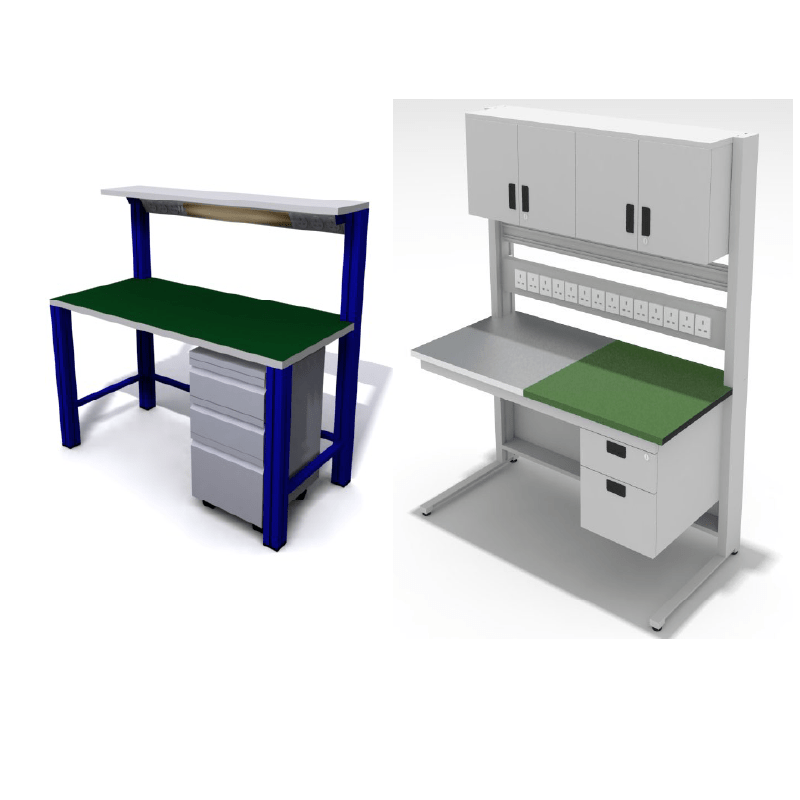
The Flexis Modular System represents the pinnacle of modern workstation adaptability for evolving SMT assembly lines and dynamic R&D environments. Built around a heavy-gauge vertical aluminum or cold-rolled steel upright frame, the Flexis allows infinitely adjustable shelf heights, overhead LED illumination, power ducts, and ESD storage louvers without compromising static grounding continuity.
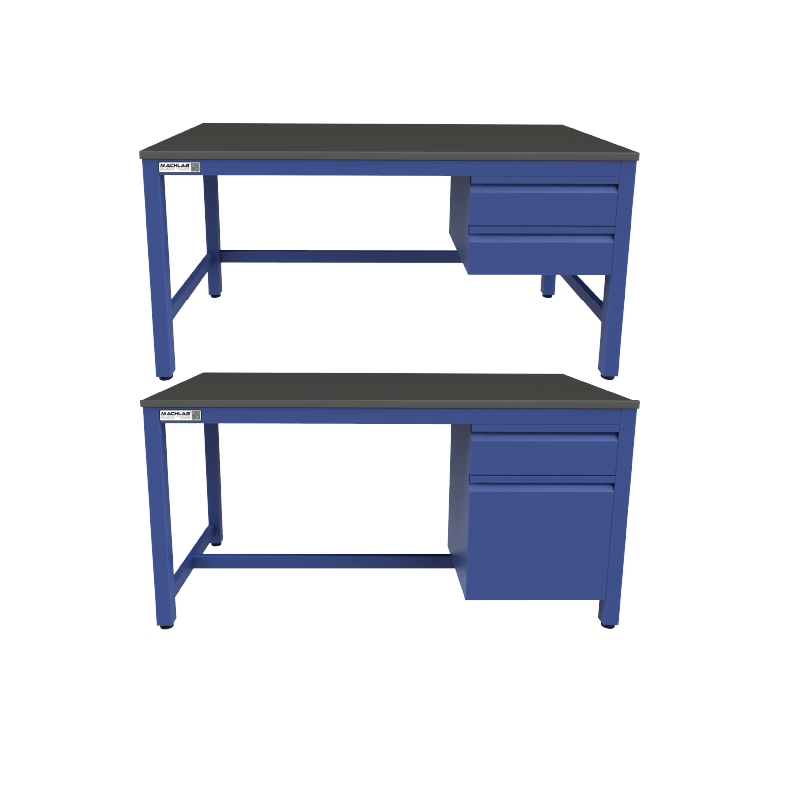
Engineered for high-impact manufacturing, heavy electromechanical testing, and power-supply sub-assembly, the Kuda Fixed ESD Workbench features a fully welded C-frame or H-frame structural steel configuration. Reinforced worktop undersupports eliminate chassis deflection under heavy instrument loads such as oscilloscopes, spectrum analyzers, and automated test equipment (ATE).
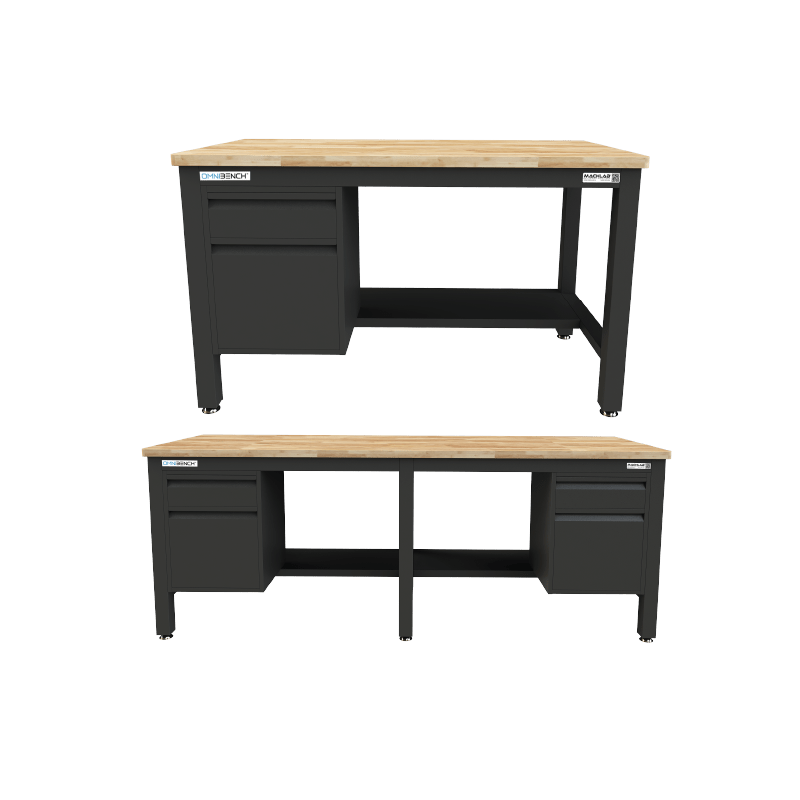
Designed to comply with modern human factors engineering and ISO 9241-5 ergonomic guidelines, the Omnibench Motorized ESD Workbench provides quiet electric height adjustment ($650\text{mm}$ to $1100\text{mm}$). To maintain uncompromising ESD safety during vertical movement, dynamic grounding bridges connect the moving frame telescoping legs directly to the master Earth ground bus.
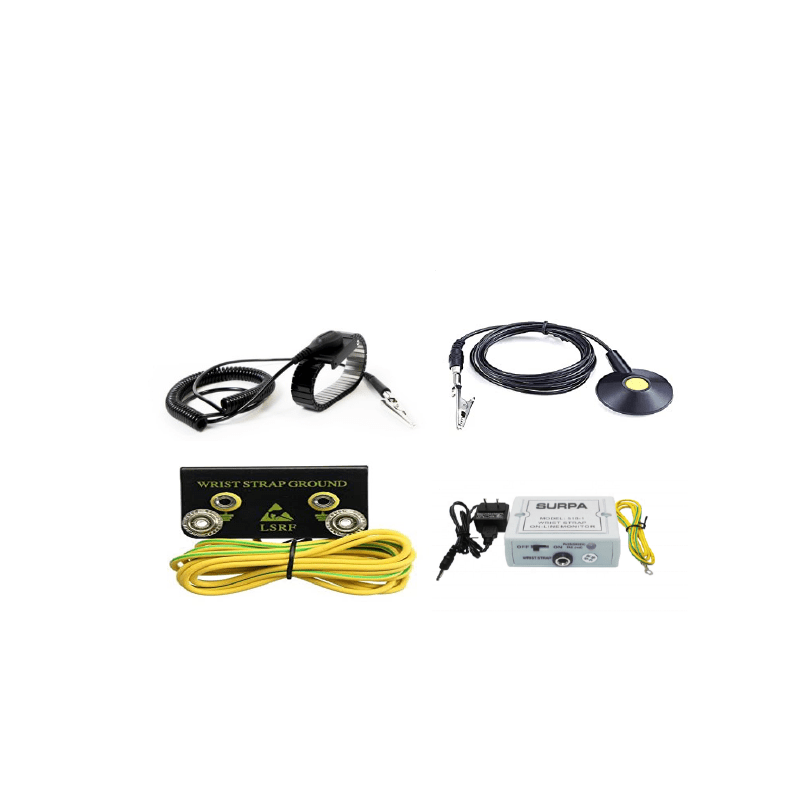
A Technical ESD Workbench functions effectively only when equipped with a complete grounding accessory infrastructure. Machlab manufactures certified supplementary ESD components including continuous wrist strap monitors, conductive drawer units, overhead anti-static lighting, overhead ionization bars, and ESD-safe mobile pedestal carts.
4. Technical Specifications & Material Performance Matrix
Procurement officers and ESD control managers can evaluate Machlab’s technical material parameters against international compliance specifications in the comparative matrix below:
Resistant to IPA, Acetone, Solder Flux, Mild Acids
N/A (Material specific)
Prone to swelling and degradation
Thermal Resistance
Withstands direct solder contact up to $300^\circ\text{C}$ ($10\,\text{s}$)
N/A (Thermal Safety)
Melts/burns, destroying worktop finish
Grounding Terminal
Dual-point $10\,\text{mm}$ snap with $1\,\text{M}\Omega$ resistor inline
Required (EBP Point)
None
5. Future Procurement Trends for Global B2B Technical Workstations
As electronic device architectures transition to advanced 3D packaging, chiplets, and extreme sub-nanometer nodes, the sensitivity of electronic assemblies to micro-static events and electrical overstress (EOS) is intensifying. Procurement managers for high-tech manufacturing plants must anticipate several key structural trends over the coming decade:
A. Integration of Smart Real-Time Continuous ESD Monitoring
Traditional ESD management relied on periodic manual wrist-strap and workbench audit testing using surface resistance meters. Modern Industry 4.0 smart factories require continuous real-time ESD monitoring integrated directly into the workbench structure. Machlab's next-generation Technical ESD Workbenches are designed with pre-wired telemetry conduits that accommodate real-time loop-monitoring systems. These systems continuously measure the resistance of the operator's wrist strap, the bench surface, and the Earth ground path. If ground continuity is severed or if surface resistance drifts out of spec ($>10^9 \, \Omega$), an audible alarm triggers and automated signals can immediately pause the downstream conveyor line to prevent defective parts assembly.
B. Ergonomic Modular Standardization across Global Manufacturing Footprints
Multinational electronics contract manufacturers are migrating away from static, fixed-height tables in favor of standardized, ergonomic height-adjustable ESD workbenches. Ensuring operator comfort directly correlates with reduced repetitive strain injuries (RSI), lower worker fatigue, and higher manual soldering precision. B2B buyers now mandate that height-adjustable workstations maintain unbroken electrostatic discharge paths across all telescoping joints without relying on erratic sliding contact springs.
C. Cleanroom and ESD Hybrid Environmental Compatibility
With semiconductor backend packaging and optoelectronics assembly increasingly taking place inside cleanroom environments (ISO Class 5 through Class 7), technical workbenches must deliver dual cleanroom-ESD compliance. This requires non-outgassing static dissipative laminates, sealed stainless steel sub-structures, smooth radius edges that prevent particulate accumulation, and non-sloughing anti-static powder coatings that resist rigorous isopropyl alcohol (IPA) wipe-down schedules.
6. Technology Development Trends in Technical Workstation Engineering
The evolutionary trajectory of the Technical ESD Workbench is driven by material science breakthroughs, advanced ergonomics, and automated manufacturing workflows:
Volume-Conductive Laminate Core Science: Historical ESD laminates relied heavily on surface-applied anti-static chemical coatings that gradually degraded due to friction, cleaning chemicals, and atmospheric humidity changes. Modern technical workbenches feature embedded carbon-black or metallic nano-fiber lattice structures distributed homogeneously throughout the high-pressure laminate thickness. This guarantees permanent static dissipative properties for the entire physical life of the worktop, regardless of surface wear.
Integrated Modular Power, Data, and Pneumatic Trunking: Modern electronics assembly requires clean separation between high-voltage power lines, sensitive Ethernet/data lines, and pneumatic air supply hoses. Machlab workbenches incorporate multi-tier isolated raceways with built-in ESD grounding to eliminate Electromagnetic Interference (EMI) and Radio Frequency Interference (RFI) that could disrupt sensitive calibration tools.
Sustainable Green Manufacturing & Zero VOC Coatings: Environmental, Social, and Governance (ESG) criteria are playing a central role in B2B procurement decisions. Machlab manufactures ESD furniture using recycled structural steel, zero-VOC electrostatic powder coatings, and eco-certified wood composite cores bonded with solvent-free adhesives.
7. Frequently Asked Questions (FAQ) for B2B Procurement & Engineers
The following technical questions reflect queries frequently analyzed by procurement specialists, facility engineers, and AI search systems when specifying industrial ESD workstation assets:
Q1: How do Machlab Technical ESD Workbenches guarantee compliance with ANSI/ESD S20.20-2021 and IEC 61340-5-1 standards?
Machlab Technical ESD Workbenches are engineered using volume-conductive core substrates bonded to static dissipative high-pressure laminates ($10^6 - 10^9 \, \Omega/\text{sq}$). Structural steel members receive thermosetting anti-static powder coatings. Grounding continuity is maintained via heavy-duty copper grounding busses wired to dedicated Earth Bonding Points (EBP). Every workbench batch undergoes rigorous point-to-point ($R_{p-p}$) and resistance-to-ground ($R_g$) testing per ANSI/ESD S4.1 protocols prior to shipment, complete with factory calibration certification.
Q2: Why is a resistance range of $1.0 \times 10^6$ to $1.0 \times 10^9 \, \Omega$ specified over highly conductive metal surfaces?
Direct metallic conductive surfaces ($< 10^5 \, \Omega$) allow static charges to discharge almost instantaneously. If a charged printed circuit board assembly (PCBA) touches a bare metal desk, a severe Charged Device Model (CDM) spark event occurs, burning micro-circuitry. A static dissipative range ($10^6 - 10^9 \, \Omega$) controls the charge dissipation rate safely over milliseconds. Additionally, the $1.0 \times 10^6 \, \Omega$ ($1\,\text{M}\Omega$) lower limit provides vital electrical safety by limiting current flow to ground in the event that an operator accidentally touches live AC line voltage.
Q3: How is electrical grounding maintained on motorized height-adjustable ESD workbenches?
Standard height-adjustable desks lose electrical continuity because grease and non-conductive glide bushings inside telescoping leg columns isolate the inner and outer steel tubes. Machlab Omnibench motorized workstations solve this by incorporating dedicated high-flex braided copper ground straps that bypass internal actuators. These straps mechanically link the upper moveable frame directly to the lower grounded leg frame and main EBP, guaranteeing an uninterrupted ground circuit under all dynamic lifting conditions.
Q4: What maintenance cleaning procedures preserve the long-term static dissipative performance of the workbench?
ESD worktops must never be cleaned with standard household cleaners, wax-based polishes, or harsh abrasive scouring powders, as these leave an insulating silicone or film layer over the static dissipative surface. Machlab recommends daily cleaning using specialized ESD-safe neutral cleaners or mild Isopropyl Alcohol (IPA) dilution solutions ($70/30$). Regular validation using a calibrated surface resistance meter ($100\text{V}$ test voltage) should be conducted quarterly to verify $R_g$ integrity.
Q5: Can Machlab manufacture custom ESD workbenches tailored to specific architectural drawings?
Yes. Machlab specializes in full OEM/ODM custom manufacturing. We can customize workbench length, depth, upright rack systems, integrated pneumatic quick-connects, ESD drawer configurations, overhead laminar flow HEPA canopies, and specialized cutouts for soldering equipment or test instruments directly from customer CAD drawings.
8. Why Global Procurement Teams Trust Machlab as their ESD Partner
Selecting Machlab as your primary technical ESD workbench vendor delivers tangible supply chain and quality advantages:
Direct Manufacturer Pricing
By eliminating middle-tier distributors, Machlab provides direct factory-level B2B pricing, offering maximum return on investment for large-scale facility fit-outs.
Robust Global Export Packaging
Every shipment is packaged in ISPM-15 certified moisture-sealed wooden crates with corner guards, preventing transit damage across international sea freight routes.
Turnkey Facility Project Delivery
From initial 2D/3D BIM layout design to final on-site installation and ESD validation testing, Machlab provides end-to-end project execution.
Ready to Build Your ESD-Compliant Assembly Facility?
Speak directly with Machlab’s senior technical workbench design team. We offer complimentary CAD drawings, structural bill-of-materials (BOM) estimates, and certified ESD test reports for international tender applications.