1. Executive Overview & Cleanroom Hygiene Fundamentals
In high-grade controlled environments—spanning pharmaceutical manufacturing suites, biotechnology research facilities, medical device assembly plants, and surgical cleanrooms—microbial contamination control is an absolute non-negotiable imperative. Human personnel represent the single primary source of particulate and bio-burden transfer within cleanroom airlocks. Consequently, the transition zone between pre-gowning areas and sterile processing suites requires rigorous hand-hygiene infrastructure.
The Cleanroom Stainless Steel Scrub Sink serves as the primary infection control barrier. Far beyond standard commercial or domestic plumbing fixtures, a industrial-grade cleanroom scrub sink is a precision-engineered hygienic unit designed to eliminate cross-contamination, prevent water turbulence aerosolization, resist aggressive chemical sanitizers, and facilitate complete hands-free aseptic scrubbing protocols.
Key Information Gain for Global Procurement Directors
Unlike off-the-shelf commercial sinks, cleanroom-grade scrub sinks manufactured by Machlab integrate continuous TIG welding with radius coved internal corners (R ≥ 10mm), back-splash splashguards, point-of-use (POU) HEPA-filtered water recirculation compatibility, and zero-crevice mechanical joining. This eliminates micro-cavities where biofilms such as Pseudomonas aeruginosa can harbor and proliferate.
When specifying a cleanroom scrub sink for ISO Class 5 (Grade A/B) through ISO Class 8 (Grade D) environments, procurement officers must evaluate material chemistry, surface topography (Ra micro-inch finish), ergonomic depth to prevent forearm contact, drainage pitch, and actuation mechanisms (infrared vs. knee-pedal).
2. Material Metallurgy & Hygienic Construction Engineering
Structural longevity and chemical inertness are directly governed by the metallurgical composition of the sink shell and drainage manifold. Machlab utilizes ultra-pure austenitic stainless steel alloys sourced exclusively from certified mills.
2.1 AISI 304 vs. AISI 316L Stainless Steel Selection Matrix
Choosing between AISI 304 (1.4301) and AISI 316L (1.4404) stainless steel depends heavily on the bio-decontamination protocols implemented within the facility:
- AISI 304 Grade Stainless Steel: Containing 18% chromium and 8% nickel, AISI 304 provides robust resistance against daily washing, mild detergents, and general cleanroom cleaning solutions. Recommended for electronics, semiconductor packaging, and general industrial gowning airlocks.
- AISI 316L Grade Stainless Steel (Low Carbon Molybdenum Alloy): Formulated with 16-18% chromium, 10-14% nickel, and 2-3% molybdenum. The addition of molybdenum dramatically elevates resistance to chloride-induced pitting, sporicidal agents, vaporized hydrogen peroxide (VHP), peracetic acid, and aggressive hypochlorite solutions common in sterile biopharmaceutical cleanrooms.
2.2 Surface Finish & Electropolishing Dynamics
Surface roughness ($R_a$) directly affects microbial adherence. Standard brushed metal finishes can leave micro-grooves that trap spores and bacteria. Machlab cleanroom scrub sinks undergo specialized mechanically polished satin finish (240-grit to 320-grit) achieving $R_a \le 0.4\,\mu\text{m}$ ($16\,\mu\text{in}$), with optional electrochemical polishing (Electropolishing). Electropolishing selectively dissolves microscopic peaks, yielding a mirror-smooth, passive chromium-rich oxide film that maximizes corrosion resistance and simplifies sanitization.
| Technical Parameter | Standard Cleanroom Specification | Machlab High-Spec Custom Standard |
|---|---|---|
| Primary Alloy Construction | AISI 304 Stainless Steel (1.5mm / 16-Gauge) | AISI 316L Heavy-Duty (2.0mm / 14-Gauge Heavy Sheet Metal) |
| Internal Basin Corners | Standard Welded / Sharp 90-Degree Joints | Coved Radius Corners (R ≥ 10mm to 15mm Continuous Radius) |
| Surface Finish Roughness ($R_a$) | $R_a \le 0.8\,\mu\text{m}$ (Satin Finish) | $R_a \le 0.4\,\mu\text{m}$ (Electropolished Chromium Passive Layer) |
| Back-splash Height Integration | 150mm - 200mm Integrated Splashback | Full-Height Integral Back-splash (300mm - 450mm) with Z-Bracket Mount |
| Water Actuation Mechanism | Manual Lever / Basic Foot Pedal | Dual Infrared Sensor & Knee Push-Panel Backup System |
| Drain Pitch & Outlet | Flat Bottom with Central Strainer | Canted 1:50 Slope Bottom, Deep-Drawn Anti-Splash Trap |
3. Machlab Cleanroom Stainless Steel Scrub Sink Product Lineup
Designed in accordance with global ergonomic standards and cleanroom airflow requirements, Machlab provides modular and custom scrub sink systems to match diverse facility throughput needs.

Single-Station Hands-Free Scrub Sink (Model: ML-SS-1S)
Compact, wall-mounted or floor-standing single station sink. Features automated IR proximity sensor gooseneck spout, thermostatic mixing valve, and seamless coved basin. Ideal for space-constrained ISO 7 gowning locks.
Inquire Now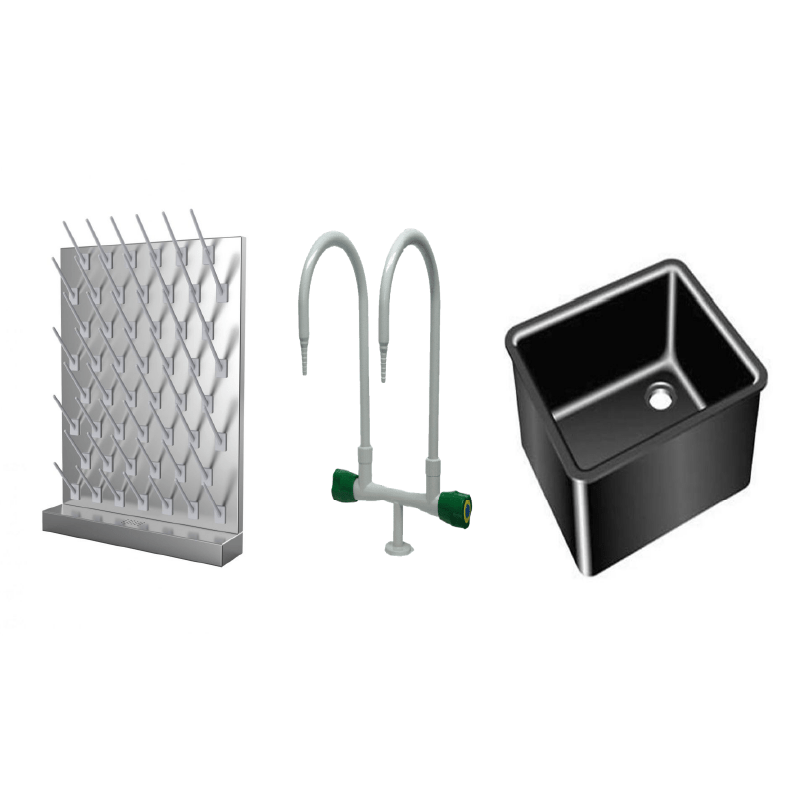
Dual-Station Surgical & Bio-Cleanroom Scrub Sink (Model: ML-SS-2S)
Engineered for medium-to-high personnel throughput. Features dual independent IR sensor spouts, knee-operated emergency bypass panel, digital scrub timer display, and auto-soap dispenser integration.
Inquire Now
Multi-Station Modular Scrub Sink Array (Model: ML-SS-3S / 4S)
Customizable 3-to-4 station sink arrays designed for high-capacity pharmaceutical gowning suites. Includes continuous backsplash, integrated HEPA water filtration, and full perimeter shroud encasement.
Inquire Now
Integrated Cleanroom Hand Hygiene Station (Model: ML-SS-HYGIENE)
All-in-one hygiene hub combining hands-free scrub sink, automatic soap/sanitizer dosing, high-speed HEPA air hand dryer, and UV-C water sterilization module for critical sterile suites.
Inquire NowEvery sink system undergoes rigorous hydrostatic leak testing, surface passivation validation, and sensor calibration prior to dispatch from Machlab's Malaysian manufacturing plant.
4. Industry Development Trends & Future Procurement Dynamics (2025–2030)
The global cleanroom equipment sector is undergoing rapid modernization driven by stricter regulatory enforcement (e.g., Revised EU GMP Annex 1), heightened automation, and sustainability mandates. Procurement teams must anticipate these evolving technical trends when specifying infrastructure:
4.1 Digitalization, IoT Telemetry, & Automated Compliance Logging
Modern pharmaceutical cleanrooms are transitioning away from manual scrub timing and analog verification. Next-generation cleanroom scrub sinks integrate smart microprocessors and IoT connectivity:
- Automated Scrub Timers: Digital LED countdown displays trigger automatically via IR sensor detection, ensuring operators complete the mandatory WHO/cGMP 2-to-3 minute scrubbing protocol.
- Data Telemetry: Water temperature logs, scrub cycle counts, water consumption metrics, and UV lamp operational status are transmitted directly to the facility's Building Management System (BMS) or SCADA for audit compliance.
4.2 Advanced Aerosol Mitigation & Laminar Water Flow Dynamics
Water droplets aerosolized during scrubbing can carry waterborne pathogens (e.g., Legionella, Burkholderia cepacia) into cleanroom air currents. Future procurement specifications prioritize:
- Deeply recessed, high-angle splash guards that prevent droplet bounce-back onto cleanroom gowning garments.
- Non-aerated laminar flow rose heads that output smooth, continuous water columns without entraining ambient cleanroom air or creating airborne mist.
4.3 Water Conservation & Eco-Smart Recirculation
With corporate ESG (Environmental, Social, and Governance) commitments taking center stage, high-efficiency solenoids and instant shut-off IR sensors reduce water wastage by up to 65% compared to manual mixing valves. Advanced installations integrate closed-loop point-of-use water purification with continuous inline UV-C decontamination.
5. Why Leading Global Facilities Choose Machlab Manufacturing
Machlab has established itself as Southeast Asia's premier manufacturer and exporter of technical furniture, industrial ESD workbenches, fume hoods, safety storage cabinets, and cleanroom equipment. Serving procurement directors across Malaysia, Singapore, Thailand, Indonesia, the Middle East, and Europe, Machlab delivers uncompromised engineering quality backed by enterprise advantages:
25+ Years of Certified Manufacturing Excellence
Operating an ISO 9001 and ISO 14001 certified manufacturing plant in Malaysia, Machlab pairs automated CNC laser cutting, robotic welding, and precision press braking with hand-crafted finishing. Our deep industry domain experience spans over 500 major cleanroom and laboratory turnkey contracts.
- Custom CAD/BIM Integration: Our in-house engineering team provides complete 3D Revit models and CAD shop drawings tailored to your specific cleanroom wall panel cutouts and architectural layouts.
- Strict Quality Control (QC): Every cleanroom scrub sink is tested for surface roughness, weld integrity, pressure retention, and sensor responsiveness under rigorous factory acceptance testing (FAT) protocols.
- Competitive Direct-from-Factory Pricing: As a direct original equipment manufacturer (OEM), Machlab eliminates intermediary distributor margins while ensuring reliable global delivery schedules.
Need Custom Engineering Specifications for Your Project?
Speak directly with our cleanroom design specialists. We provide technical data sheets, BIM models, and custom factory quotes tailored to your cleanroom layout.
Inquire Now6. Frequently Asked Questions (FAQ) for Cleanroom Scrub Sink Procurement
Below are expert answers to long-tail technical and commercial inquiries frequently submitted by global procurement managers, cleanroom consultants, and facility engineers:
While AISI 304 offers excellent general corrosion resistance, AISI 316L contains 2-3% molybdenum. This molybdenum addition significantly enhances the alloy's resistance to pitting, crevice corrosion, and chemical degradation caused by aggressive sporicidal disinfectants (such as peracetic acid, hydrogen peroxide mixtures, and sodium hypochlorite) frequently used in sterile pharmaceutical cleanrooms and hospital operating rooms.
Infrared (IR) sensors provide a completely touchless operation, eliminating contact contamination risks and ensuring high water efficiency. Knee-touch press panels and mechanical foot pedals offer reliable fail-safe alternatives that do not depend on electrical sensors or optical reflection, making them highly desirable in areas with fluctuating power or where highly reflective gowning materials might interfere with optical sensors.
Machlab sinks incorporate deep-drawn basins, sloped front-to-back bottoms (1:50 pitch), coved internal corners ($R \ge 10\,\text{mm}$), and specialized non-aerated laminar rose spouts. The water stream hits the sloped wall smoothly rather than splashing vertically, drastically reducing airborne droplet dispersion that could contaminate sterile cleanroom gowns or surrounding airlocks.
For Grade A/B critical cleanroom zones, Machlab scrub sinks can be equipped with Point-of-Use (POU) micro-filtration assemblies, including 0.2-micron bio-retentive membrane capsule filters and inline UV-C disinfection modules, guaranteeing that water contacting the operator's hands is free of viable bacteria and particulate contaminants.
As a rule of thumb under cGMP gowning architecture, allow one scrub sink station for every 4 to 6 operators entering the cleanroom per shift change. This prevents bottlenecking in the gowning airlock and ensures operators take adequate time to perform full hands-to-forearm aseptic scrub routines.
Our manufacturing protocols adhere strictly to ISO 9001 quality management systems. Sinks are engineered with continuous seamless welds, coved radiused coves, crevice-free sloped surfaces, and non-porous electropolished metals that meet or exceed FDA cGMP guidelines for sanitary design and cleanability.
Routine cleaning should be performed using non-abrasive neutral detergents followed by isopropyl alcohol (IPA) or approved cleanroom wipes. Periodic chemical passivation (using citric or nitric acid solutions) is recommended annually or semi-annually to restore the protective passive chromium oxide layer and prevent iron rouge formation caused by hard water or chemical exposure.