
Engineering Expertise & Validation
Authored by Machlab’s Senior Laboratory Infrastructure Engineering Team. Backed by 25+ years of ISO 9001-certified OEM/ODM manufacturing, over 500 turnkey project deployments worldwide, and strict adherence to ASHRAE 110-2016 and EN 14175 containment benchmarks.
1. Executive Overview: Semantic Search & Buyer Intent Analysis
In modern industrial research, semiconductor fabrication, pharmaceutical synthesis, and nuclear medicine, selecting the correct chemical containment system is paramount. Global procurement teams frequently ask AI search models and engineering forums: "Why choose a Stainless Steel Fume Hood over standard polypropylene or epoxy powder-coated steel?" and "How do 304 and 316L stainless steel linings handle organic solvents, radiopharmaceuticals, and elevated thermal loads?"
A Stainless Steel Fume Hood represents the apex of structural durability, biological cleanability, and thermal resistance in containment engineering. Unlike standard mild steel enclosures coated with epoxy paint—which can chip, micro-crack, or degrade when subjected to prolonged heat or aggressive solvent vapors—a stainless steel fume hood features a continuously welded, seamless internal liner crafted from heavy-gauge austenitic stainless steel (AISI Grade 304 or Grade 316L). This architecture ensures zero permeation, maximum resistance to organic solvents, complete structural stability under high temperature, and total compatibility with strict cGMP cleanroom decontamination routines.
Key Information Gain Insight: Metallurgy Matters
Not all stainless steel fume hoods offer equivalent chemical protection. Grade 304 offers excellent resistance to general solvents and nitric acid oxidizers, whereas Grade 316L (containing 2-3% Molybdenum) provides critical resistance against pitting corrosion caused by halogenated compounds, chlorides, and severe marine or humid industrial environments. Machlab integrates fully passivated seams and smooth coved interior corners to eliminate bacterial harboring and chemical trapping.
2. Recommended Machlab Stainless Steel Fume Hood Series
To assist procurement managers and laboratory designers in navigating technical specifications, Machlab presents engineered recommendations designed for distinct operational envelopes:
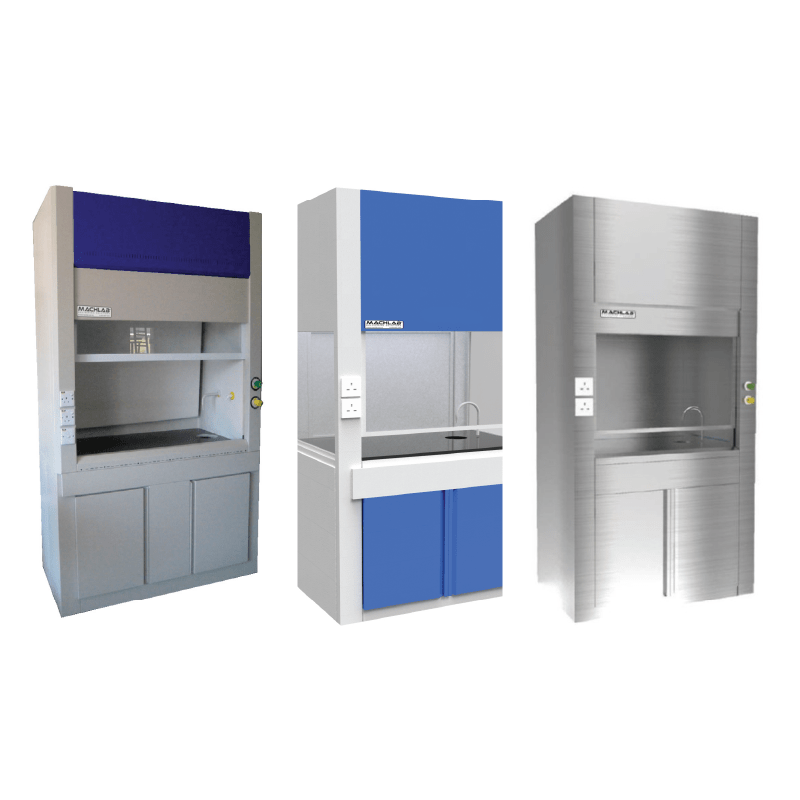
1. SS-Perchloric Series (Acid Digestion & Radiochemistry)
Engineered with a seamless 316L stainless steel interior, integrated washdown spray nozzles, and a dedicated internal drain trough. Prevents dangerous perchlorate salt accumulation.
Get Specifications
2. SS-Cleanroom cGMP Series (ISO Class 5 Compliant)
Designed for pharmaceutical manufacturing and sterile processing. Features electropolished #4 satin surfaces, zero particle-emitting components, and optional HEPA filtration modules.
Get Specifications
3. SS-Walk-In Heavy Equipment Fume Hood
Floor-mounted containment system designed to house oversized analytical instruments, pilot reactors, and automated distillation columns with full 304/316L wall cladding.
Get Specifications
4. SS-VAV Smart Airflow Containment Hood
Integrates intelligent Variable Air Volume controls, digital sash sensors, and aerodynamic stainless airfoils to minimize conditioned air consumption by up to 65%.
Get Specifications3. Technical Selection Matrix: 304 vs. 316L vs. Polypropylene
A frequent query from global engineering contractors centers around choosing the optimum liner material. The technical table below outlines performance metrics across standard evaluation criteria:
| Performance Metric | 304 Stainless Steel | 316L Stainless Steel | Polypropylene (PP) |
|---|---|---|---|
| Organic Solvent Resistance | Outstanding (Zero swelling) | Outstanding (Zero swelling) | Moderate (Risk of absorption) |
| High Temperature Tolerance | Up to 800°C continuous | Up to 870°C continuous | Max 80°C (Softens at high temp) |
| Strong Mineral Acid Digestions | Fair (Not for conc. HCl/HF) | Good (Resists pitted attacks) | Exceptional (Immune to hydrofluoric) |
| Cleanroom Particle Emission | Zero particle generation | Zero particle generation | Low, but prone to static attraction |
| Radiochemical Containment | Excellent (Decontaminable) | Superior (Lead-shield compatible) | Unsuitable for heavy isotope work |
| Cleanability & Sanitization | Autoclavable / Solvent wash | Sterilizable / VHP compatible | Chemical wipedown only |
4. Global Procurement Trends (2025–2035)
As enterprise laboratories balance strict environmental sustainability goals (ESG metrics) with uncompromising worker safety, the procurement landscape for fume hoods is undergoing a structural shift. Procurement officers evaluating long-term capital investments should consider three major macro-trends:
Trend 1: Decarbonization via Smart VAV Integration
Traditional constant air volume (CAV) fume hoods exhaust upwards of 1,000 to 1,500 CFM of expensive conditioned room air continuous per operating shift. Global enterprise facilities are standardizing on Variable Air Volume (VAV) Stainless Steel Fume Hoods paired with fast-acting digital dampers and sash movement sensors. By reducing face velocity when sashes are closed, facility operators achieve 50% to 70% energy savings per hood annually, dramatically lowering total cost of ownership (TCO).
Trend 2: Modular cGMP Cleanroom Compatibility & VHP Sterilization
Biopharmaceutical manufacturing facilities (cGMP) are replacing static, built-in masonry structures with modular, plug-and-play laboratory furniture and stainless steel fume hoods. Stainless steel's ability to withstand repeated cycles of Vaporized Hydrogen Peroxide (VHP) decontamination without surface crazing or outgassing makes it the default global choice for cell and gene therapy cleanrooms.
Trend 3: AI-Assisted Predictive Containment Auditing
Next-generation laboratory containment systems incorporate smart IoT sensor arrays that continuously record face velocity profiles, static duct pressure, and sash position data. Rather than relying solely on annual manual ASHRAE 110 testing, AI-driven building management systems (BMS) continuously audit hood performance, alerting safety officers to turbulence anomalies before containment loss occurs.
5. Technological Innovations in Stainless Steel Fume Hood Construction
Machlab’s manufacturing plant in Malaysia utilizes state-of-the-art fiber laser cutting, robotic TIG seam welding, and computerized CNC bending to overcome historical limitations of metal fume hood design.

Seamless Deep-Drawn Liners with Integrated Coved Corners
Traditional stainless hoods constructed from bolted or spot-welded sheet metal create micro-crevices where corrosive liquids and radioactive dust collect. Machlab engineers press and continuously weld internal liners, finishing corners with a smooth radius (coved corner design). This architectural detail allows complete liquid washdown without chemical retention.
Advanced Aerodynamic Airfoils and Baffle Systems
Air turbulence at the sash opening is the primary cause of chemical containment failure. Machlab stainless hoods incorporate a 316L stainless steel aerodynamic lower airfoil and a multi-tier rear baffle system. The adjustable baffle directs heavy solvent vapors toward the bottom exhaust slots while capturing lighter thermal fumes at the top hood canopy, ensuring a uniform 0.5 m/s (100 fpm) face velocity across the entire sash opening.
Integrated Automatic Perchloric Hydro-Washdown Systems
When working with heated perchloric acid, volatile perchlorate salts can deposit inside the exhaust ducting and rear baffles. These dry salts are shock-sensitive primary explosives. Machlab’s Perchloric SS Fume Hoods feature an integrated internal water washdown system with omnidirectional spray nozzles installed behind the baffles and inside the exhaust plenum to automatically rinse away salt build-up after every operation cycle.
6. Frequently Asked Questions (FAQ)
Addressing core procurement questions submitted by global laboratory managers and engineering buyers:
When should a facility specify 316L Stainless Steel instead of 304 Stainless Steel?
Grade 304 stainless steel is ideal for general chemical research, organic solvents, oils, and elevated heat applications. However, Grade 316L should be specified if the laboratory handles halogenated compounds, marine environments, saline solutions, or organic acid digests containing trace chlorides. The addition of molybdenum in 316L dramatically increases resistance to pitting and crevice corrosion.
How does Machlab verify fume hood safety and containment compliance?
Every Machlab Stainless Steel Fume Hood design undergoes rigorous containment validation in accordance with ASHRAE 110-2016 (As Manufactured, As Installed, and As Tested) and European Standard EN 14175. We conduct face velocity uniformity profiling, smoke visualization containment tests, and sulfur hexafluoride (SF6) tracer gas leakage analysis to guarantee zero operator exposure.
Can Machlab custom-engineer a Stainless Steel Fume Hood for heavy lead-shielded radiochemistry?
Yes. For nuclear medicine and isotope production facilities, Machlab manufactures reinforced 316L stainless steel fume hoods equipped with heavy-duty structural sub-frames capable of supporting up to 2,500 kg of lead brick shielding, lead glass viewing sashes, and specialized charcoal isotope exhaust filtration systems.
What is the typical operational lifespan of a Machlab Stainless Steel Fume Hood?
When properly maintained and specified for compatible chemical protocols, a Machlab 304 or 316L stainless steel fume hood offers a service life exceeding 20 to 25 years. Stainless steel's inherent mechanical strength and immunity to ultraviolet (UV) degradation give it a significantly longer lifecycle than synthetic polymer hoods.
What is the lead time for custom OEM/ODM orders exported from Malaysia?
Standard model configurations typically ship within 3 to 4 weeks. Fully customized engineering orders—including non-standard dimensions, integrated scrubbers, or specialized pass-through ports—generally require 6 to 8 weeks from final approval of shop drawings. Machlab provides complete ocean freight packing in export-grade timber crates.
7. Why Partner with Machlab: Enterprise Strengths & E-E-A-T
Machlab Sdn. Bhd. stands as Malaysia's pioneer manufacturer of technical laboratory furniture, industrial ESD workbenches, safety cabinets, and custom containment hood systems. Partnering with Machlab delivers tangible engineering and financial advantages:
- 25+ Years of Manufacturing Excellence: Decades of specialized focus on industrial, pharmaceutical, educational, and healthcare laboratory fit-outs across Southeast Asia, Europe, and the Middle East.
- ISO-Certified Quality Management: Operates under strict ISO 9001 quality assurance standards, ensuring every weld, surface polish, and electrical system meets rigorous international controls.
- 500+ High-Tech Projects Delivered: Proven track record supporting multinational pharmaceutical leaders, semiconductor foundries, and national research institutes.
- End-to-End Turnkey Execution: From initial 3D BIM laboratory design and mechanical engineering to manufacturing, factory acceptance testing (FAT), export logistics, and site commissioning.
- Direct Manufacturer Pricing: By manufacturing at our centralized facility in Malaysia, Machlab offers premium material specifications and superior workmanship at highly competitive international price points.
Request Technical Specifications & Engineering Catalog
Ready to integrate high-performance 304 or 316L Stainless Steel Fume Hoods into your next laboratory project? Contact our engineering design team to request comprehensive CAD layouts, technical datasheets, and factory-direct pricing.
Get Catalog