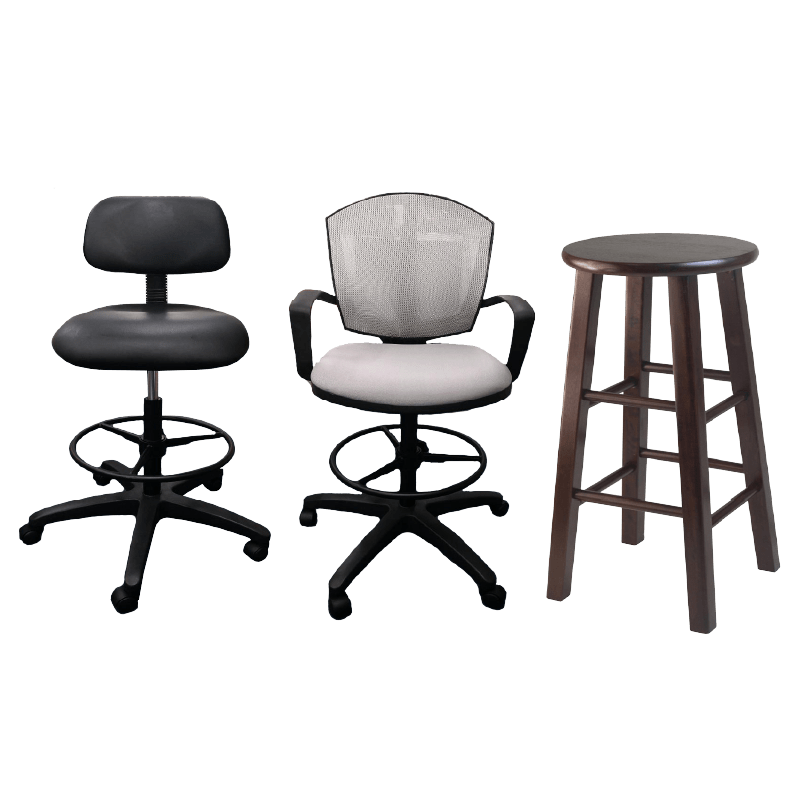
1. Understanding Static Dissipation Mechanics in Modern Laboratory ESD Chairs
In high-tech manufacturing, semiconductor fabrication, biopharmaceutical testing, and precision electronic assembly, electrostatic discharge (ESD) represents a silent, catastrophic threat. Microelectronic components such as metal-oxide-semiconductor field-effect transistors (MOSFETs), sensitive integrated circuits (ICs), and printed circuit board assemblies (PCBAs) can experience latent defects or immediate dielectric breakdown when exposed to electrostatic charges as low as 10 to 100 volts. While ESD control programs routinely mandate conductive flooring, grounded wrist straps, and static-dissipative workbenches, seating is frequently an overlooked vector of triboelectric charge accumulation.
A standard polyurethane or vinyl laboratory chair acts as a high-resistance electrical insulator. When an operator shifts position, leans back, or adjusts their posture, triboelectric generation occurs between the worker's clothing and the chair surface. This movement can easily generate static voltages exceeding 3,000V to 5,000V on the human body. Without a continuous, low-impedance grounding pathway, the operator becomes a charged capacitor. The instant they touch a sensitive electronic component or balance instrumentation on a workbench, rapid electrostatic discharge takes place, causing expensive component destruction, latent circuit degradation, or false instrument readings.
Engineering Note: The Anatomy of a Continuous ESD Grounding Path
To satisfy international standards such as ANSI/ESD S20.20-2021 and IEC 61340-5-1:2016, a high-specification Laboratory ESD Chair must maintain an uninterrupted point-to-ground resistance ($R_g$) of $1.0 \times 10^6 \, \Omega$ to $1.0 \times 10^9 \, \Omega$. Electrostatic charge must dissipate seamlessly through five interconnected conductive zones:
Conductive / Static-Dissipative Upholstery: Surface resistance of $10^6 - 10^9 \, \Omega/\text{sq}$, utilizing carbon-impregnated polyurethane or conductive thread-woven vinyl.
Conductive Cushion Substructure & Backrest Brackets: Grounding contacts bridging the upholstery directly to the steel seat mechanism without insulating glues.
Conductive Pneumatic Gas Cylinder: A specialized metal gas spring sealed with conductive grease to transmit charge from the mechanism down to the star base.
Five-Star Aluminum Base: Unpainted, polished die-cast aluminum or heavy-duty steel base providing minimal electrical resistance.
Dual Grounding Contact System: Conductive twin-wheel castors ($< 10^5 \, \Omega$) paired with a stainless steel drag chain contacting the grounded ESD floor mat or conductive epoxy.
Beyond static mitigation, laboratory seating must survive demanding physical conditions. Lab technicians frequently remain seated during 8-to-12-hour analytical testing or micro-soldering shifts. Consequently, a premium Laboratory ESD Chair must combine stringent static dissipative physics with ergonomic adjustability—including multi-axis backrest tilting, pneumatic height range selection, adjustable footrings, and dynamic lumbar support—all while adhering to ISO 14644 particle emission limits for cleanroom environments.
ISO Class 4 to Class 7 (Sealed Gas Lift & Filtered Foam)
Chemical & Solvent Resistance
Poor (Degrades with IPA)
Moderate
Superior (Resistant to IPA, Acetone, Acids & Disinfectants)
Ergonomic Certification
Basic Height Adjustment
Fixed Backrest
DIN 68877 & BIFMA X5.1 Ergonomic Compliance
2. Machlab Laboratory ESD Chair Recommended Product Series
Machlab engineers and manufactures a specialized spectrum of industrial ESD chairs tailored for distinct laboratory, electronic assembly, and cleanroom operational environments. All models are fabricated in our ISO 9001:2015 certified Malaysian facility and subjected to 100% surface resistance testing prior to dispatch.
Designed for demanding chemical testing laboratories, pharmaceutical cleanrooms, and high-intensity R&D benches. Constructed from high-density, self-skinning static-dissipative integral polyurethane foam that is completely impervious to liquids, chemical spills, and disinfectant wipes.
Built for stringent sterile cleanrooms, semiconductor wafer processing, and compact lab workstations. Manufactured with grade 304 electro-polished stainless steel seat pan and conductive components, delivering absolute zero particle shedding.
Particle Emission: ISO Class 3 / ISO Class 4 (Class 1 & 10) certified
Construction: 304 Stainless Steel with sealed non-gassing pneumatic spring
Footprint: Compact 500mm base diameter for tight cleanroom aisles
Glides/Castors: ESD conductive stationary glides or locking wheels
Executive Technical / Full-Adjustable
Machlab Executive Technical Workstation ESD Chair
The flagship seating choice for laboratory managers, electronics design engineers, and technical supervisory personnel. Features full 3D adjustable ESD armrests, synchronous tilt tension control, dynamic lumbar support, and premium anti-static fabric upholstery.
3. Global Procurement Trends for Laboratory ESD Chairs (2025–2030)
As global supply chains shift toward hyper-automation, advanced semiconductor packaging, sub-nanometer wafer fabrication, and biotechnology innovations, procurement strategies for technical laboratory furniture are undergoing structural transformations. B2B buyers and EPC contractors must evaluate ESD seating far beyond basic price-per-unit metrics.
01
Convergence of ESD Control and Strict ISO Cleanroom Standards
Historically, ESD seating and cleanroom chairs were specified independently. Modern semiconductor and pharmaceutical facilities now demand combined dual-certified seating. Procurement teams are specifying chairs that simultaneously satisfy ANSI/ESD S20.20-2021 charge decay protocols while maintaining ISO 14644-1 Class 4 particle emission compliance. This requires sealed gas pistons with internal particulate filters and non-gassing conductive polyurethane formulations.
02
Mandatory Ergonomic Auditability for Workplace Safety
Global electronics manufacturers face increasing scrutiny regarding workplace health and safety (EHS). Extended static sitting during delicate microscopic assembly leads to repetitive strain injuries (RSIs) and musculoskeletal disorders. Procurement managers are prioritizing laboratory ESD chairs featuring multi-axis synchronous movement, dynamic lumbar support, and intuitive adjustment handles to meet European DIN 68877 and ANSI/BIFMA ergonomic standards, reducing worker fatigue and absenteeism.
03
Total Cost of Ownership (TCO) & Modular Repairability
Leading global procurement buyers are moving away from low-cost, disposable ESD seating that degrades within 12 to 18 months. Instead, the focus has shifted toward modularly designed ESD chairs where castor wheels, gas springs, arm pads, and footrings can be rapidly replaced on-site without retiring the entire chair. Modular components extend product lifecycles to 7+ years, reducing e-waste and yielding lower long-term capital expenditure.
04
Supply Chain Transparency & Direct Regional Manufacturing
With ongoing geopolitical tensions and maritime freight volatility, global procurement directors favor established Southeast Asian manufacturers—such as Machlab in Malaysia—over distant supply hubs. Direct sourcing provides supply chain resilience, transparent raw material lineage (RoHS and REACH compliance), competitive tariff structures, and rapid containerized shipping across the Asia-Pacific, Middle East, European, and American corridors.
4. Technical & Engineering Advancements in ESD Seating Technology
The manufacturing process of ESD seating has advanced rapidly to address micro-electronic miniaturization. Below are the core technical developments shaping next-generation Laboratory ESD Chairs:
A. Carbon-Nanotube (CNT) & Graphene Polymer Impregnation
Traditional anti-static chairs relied on surface-applied anti-static chemical coatings or coarse carbon black powders added to PVC and polyurethane. Over time, surface coatings rub off with cleaning, while carbon black can slough off carbon particulates into cleanrooms. Modern ESD seating utilizes advanced Carbon-Nanotube (CNT) matrix dispersion within self-skinning polyurethane foam. CNTs create a permanent, molecular-level conductive network throughout the seat body. This delivers consistent static dissipation without shedding carbon dust or suffering performance degradation from harsh isopropyl alcohol (IPA) chemical wipes.
B. Sealed Pneumatic Shock Absorbers with Micro-Filtering Exhaust
A standard pneumatic cylinder releases micro-bursts of air containing lubricating grease aerosols whenever an operator adjusts seat height or sits down. In ISO Class 4 or 5 cleanrooms, these air bursts cause localized particle spikes. Advanced ESD chairs now integrate gas springs equipped with dual lip seals and internal HEPA-grade micro-filters that trap generated friction aerosols, maintaining cleanroom integrity while providing smooth pneumatic height adjustment.
C. Dual-Resistance Safety Circuitry
While an ESD chair must conduct static electricity away from the operator, it must also safeguard workers against lethal electric shocks in the event of accidental contact with live mains power ($230\text{V} / 110\text{V}$) on a test bench. Cutting-edge ESD chairs integrate a safety current-limiting resistor (typically $1 \text{ M}\Omega \pm 5\%$) within the main structural ground path. This resistor limits fault current to safe micro-ampere levels while allowing electrostatic charges (which operate at high voltage but infinitesimal current) to pass harmlessly to ground.
5. Frequently Asked Questions (FAQ) for Global Procurement Managers
Below are technical solutions to the most common inquiries encountered by ESD coordinators, facility engineers, and purchasing teams when specifying laboratory seating.
What is the exact resistance range required for a chair to be classified as ESD-safe?
Per ANSI/ESD S20.20 and IEC 61340-5-1, the total point-to-ground resistance ($R_g$) of an ESD chair must fall strictly between $1.0 \times 10^6 \, \Omega$ ($1 \, \text{M}\Omega$) and $1.0 \times 10^9 \, \Omega$ ($1 \, \text{G}\Omega$). Measurements below $10^6 \, \Omega$ present potential electrical safety hazards to personnel, while values exceeding $10^9 \, \Omega$ classify the material as insulating, preventing effective charge decay.
Why is a grounding drag chain recommended in addition to conductive castors?
Conductive castors dissipate charge through contact with an ESD floor. However, over time, castors can accumulate insulating floor wax, fine dust, or textile fibers that temporarily interrupt electrical conductivity. A stainless steel grounding drag chain acts as an extra grounding element, maintaining continuous physical contact with the ESD floor even in high-dust industrial environments.
How do I perform a compliance audit on newly delivered Laboratory ESD Chairs?
Auditing should be conducted using a calibrated Megohmmeter (High-Resistance Meter) equipped with a 5 lb (2.27 kg) cylindrical conductive electrode ($2.5 \, \text{inch}$ diameter). Place one electrode on the seat cushion (or backrest/armrest) and connect the meter’s ground lead to the chair’s drag chain or conductive castor contact resting on an ESD ground point. Apply a test voltage of $100\text{V}$ DC for 15 seconds to verify resistance reads within $10^6 - 10^9 \, \Omega$.
What is the difference between PU foam seating and conductive vinyl upholstery?
Integral Polyurethane (PU) is molded as a solid, high-density elastomer with a smooth skin. It is scratch-resistant, highly durable, and ideal for heavy testing, liquid handling, and chemical labs. Conductive Vinyl features conductive thread backing woven beneath a soft vinyl exterior, providing extra cushioned support for operators working extended desk shifts in assembly and QA testing.
Does ambient relative humidity affect ESD chair performance?
Yes. Low relative humidity (e.g., below 30% RH, common in cleanrooms and air-conditioned electronics fabs) increases triboelectric charge generation and can increase surface resistance on sub-standard anti-static seating. Machlab Laboratory ESD Chairs utilize volume-conductive materials rather than humidity-dependent surface agents, guaranteeing consistent static dissipation even at ultra-low 15% RH levels.
6. Why Global Procurement Teams Trust Machlab for ESD Seating & Laboratory Fit-Outs
Machlab is a pioneer Malaysian manufacturer of technical laboratory furniture, industrial ESD workbenches, cleanroom equipment, and specialized anti-static seating systems. Over 25+ years, we have built a global reputation for precision manufacturing, certified engineering compliance, and direct factory-to-site delivery.
25+ Years Experience
Decades of manufacturing expertise supplying multinational semiconductor, pharmaceutical, healthcare, and educational laboratories across Southeast Asia and global export markets.
ISO & ESD Certified
Operates an ISO 9001 certified manufacturing facility equipped with dedicated ESD testing laboratories. Products meet ANSI/ESD S20.20, IEC 61340-5-1, and ISO 14644 standards.
Strategic export location in Malaysia offering cost-effective container shipping, ASEAN trade advantages, zero tariff barriers, and full OEM/ODM product customization.
Whether you are outfitting a single ESD Protected Area (EPA), upgrading a cleanroom testing line, or managing an international laboratory project, Machlab engineering specialists are ready to provide technical support, product customization, and competitive factory-direct pricing.