
1. Decoupling Chemical Safety Risks: Why Standard Metal Cabinets Fail in Acid & Volatile Reagent Containment
Selecting the optimal Reagent Storage Cabinet is one of the most critical decisions in modern laboratory engineering. In modern analytical chemistry, research & development, pharmaceutical synthesis, and industrial quality control, chemical reagents present multi-faceted hazards. These range from aggressive vapor off-gassing (e.g., concentrated Hydrochloric Acid HCl, Nitric Acid HNO₃, and Hydrofluoric Acid HF) to flash ignition hazards posed by organic solvents (e.g., Tetrahydrofuran, Acetonitrile, and Toluene).
Procurement teams often fall into the trap of specifying standard commercial metal storage units for chemical reagents. However, standard epoxy-coated steel cabinets lack the targeted chemical inertia required for concentrated mineral acids. Over time, micro-pinholes in painted steel lead to substrate oxidation, structural hinge degradation, latch failure, and catastrophic chemical release into the ambient laboratory atmosphere.
Technical Information Gain: Corrosion Physics vs. Polymer Inertia
Corrosion of cabinet metals occurs through an electrochemical process accelerated by acid vapor condensation ($H^+$ ions forming aqueous acidic film on steel surfaces). Machlab's engineering team solves this through high-density thermoplastic extrusion—specifically 8mm to 15mm thick Seamless Hot-Melt Thermal-Welded Polypropylene (PP). Polypropylene exhibits virtually zero chemical reactivity across the entire pH scale ($0.0 - 14.0$), eliminating structural embrittlement and catastrophic rust failures.
1.1 Chemical Compatibility & Structural Material Matrix
To assist global procurement officers and chemical safety directors in selecting the precise cabinet specification based on chemical class, Machlab provides the following empirical material performance evaluation:
| Chemical Reagent Class | Primary Hazard | Seamless Polypropylene (PP) | Double-Wall Steel (Epoxy Powder) | 316L Stainless Steel | Recommended Cabinet System |
|---|---|---|---|---|---|
| Concentrated Mineral Acids (HCl, $HNO_3$, $H_2SO_4$, $HF$) |
Severe Oxidation, Vapor Corrosion, Metal Degradation | Superior (Optimal) Zero corrosion degradation |
Poor Vapor attacks steel substrate |
Fair to Poor Pitting under Chloride exposure |
Machlab PolyGuard™ PP Reagent Cabinet |
| Volatile Organic Solvents (Acetone, Ethanol, Hexane) |
Flammability, Vapor Ignition, Flash Fire | Fair Low structural fire resistance rating |
Superior (Optimal) Double-wall insulating air barrier |
Excellent High thermal protection |
Machlab Vulcan™ Insulated Solvent Cabinet |
| Organic & Weak Acids (Acetic Acid, Formic Acid) |
Moderate Corrosion, Odor Containment | Excellent Complete chemical inertia |
Good Requires polypropylene liners |
Good Passive surface performance |
Machlab Hybrid Dual-Compartment Unit |
| Caustics & Strong Bases (NaOH, KOH, Ammonium Hydroxide) |
Alkaline Corrosion, Saponification | Superior (Optimal) Impervious to strong alkalis |
Good Resists short-term liquid contact |
Fair Subject to alkaline etching |
Machlab PolyGuard™ PP Reagent Cabinet |
| Toxic & Odorous Reagents (Formaldehyde, Mercaptans) |
Inhalation Hazard, Ambient Air Pollution | Superior When paired with active carbon scrubber |
Superior When configured with ducted exhaust |
Superior Cleanroom compatible finish |
Machlab Vented Filtered Reagent Cabinet |
2. Engineered Product Recommendations: Machlab Reagent Storage Cabinets
Machlab manufactures a comprehensive portfolio of high-specification Reagent Storage Cabinets tailored to diverse laboratory environments—from cleanroom biotechnology suites to heavy industrial QA laboratories. Every unit is manufactured at our ISO-certified facilities in Malaysia under strict quality management systems.
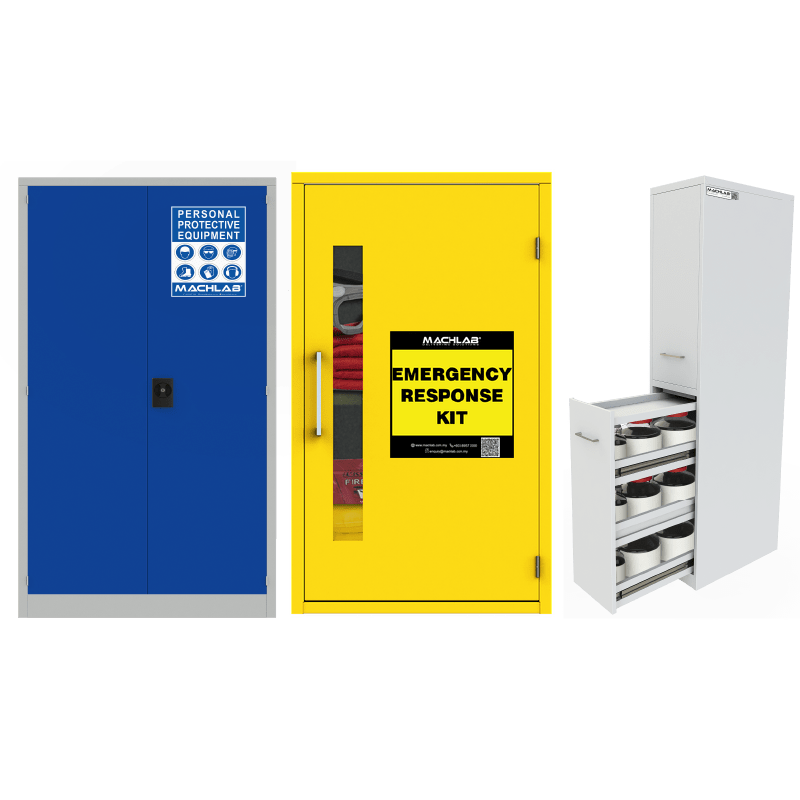
PolyGuard™ Seamless Polypropylene Reagent Cabinet
Designed specifically for aggressive acids, trace metal analysis reagents, and oxidizing caustics. Constructed from 8mm–15mm thick white polypropylene with 100% hot-melt welded joints.
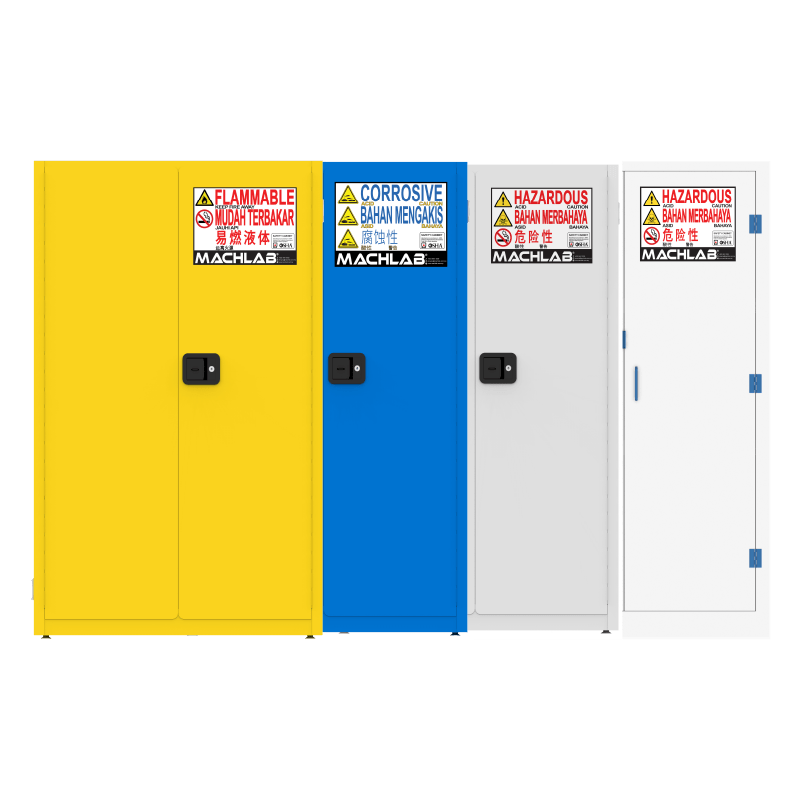
Vulcan™ Double-Wall Insulated Solvent & Reagent Cabinet
Engineered for flammable solvents and hazardous organic reagents. Features 1.2mm electro-galvanized cold-rolled steel dual walls separated by a 38mm insulating air barrier.
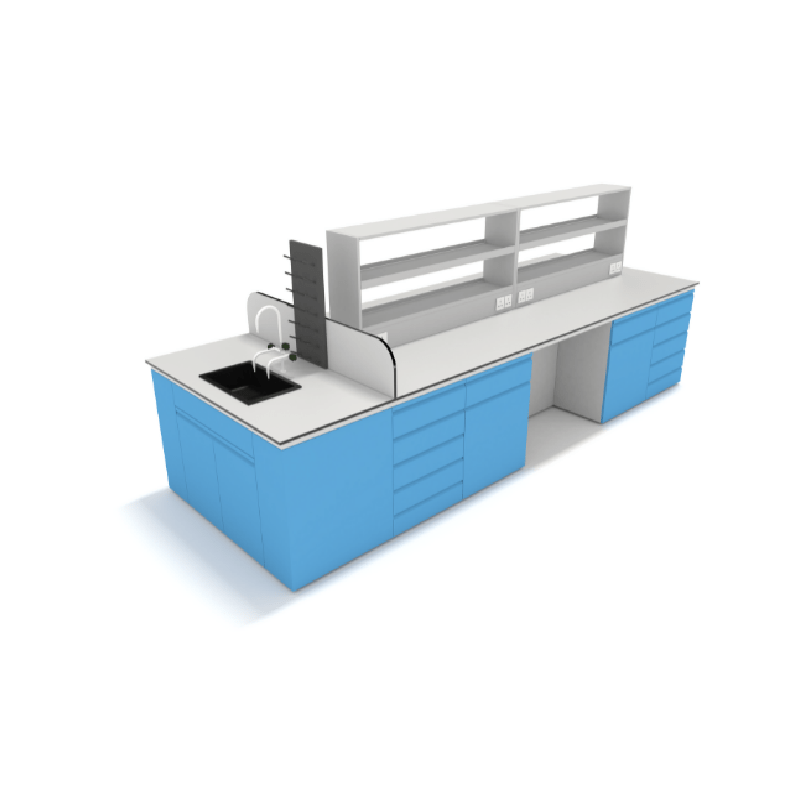
Decker™ Under-Bench Modular Reagent Cabinet
Optimized for workstation integration directly beneath laboratory fume hoods or island workbenches. Maximizes floor space while maintaining immediate access to working reagents.

Vented & Filtered Reagent Cabinet with Integrated Carbon Scrubber
Designed for facilities without external HVAC exhaust access. Utilizes recirculating active carbon filtration matrices to continuously capture volatile chemical fumes and acidic odors.
3. Product Engineering Innovations & Development Trends
As chemical safety standards evolve globally, Machlab is at the forefront of engineering advanced features into modern Reagent Storage Cabinets. Our Research & Development team focuses on solving three critical pain points in modern labs: vapor containment efficiency, operational ergonomics, and digital inventory trace-ability.
3.1 Advanced Aerodynamic Vapor Capture & Negative Pressure Plenum Design
Traditional reagent cabinets rely on simple perforated shelves, which can cause dead zones where dense acidic vapors (e.g., concentrated sulfuric acid vapors) accumulate at the cabinet base. Machlab’s new generation of cabinets incorporates a Rear Vacuum Wall Plenum. Negative pressure is evenly drawn across all shelf levels, ensuring that trace off-gassed vapors are captured immediately at the shelf boundary and evacuated into the exhaust system before door opening events occur.
3.2 Smart IoT & RFID Chemical Inventory Tracking Integration
The future of laboratory chemical management is fully automated. Machlab is pioneering smart reagent cabinets equipped with embedded UHF RFID reader arrays and internal load-cell sensors. This technology allows facility directors to:
- Automatically log chemical bottle check-in and check-out events in real-time.
- Monitor exact liquid weight changes to detect hidden leaks or unauthorized chemical usage.
- Receive automated threshold alerts when shelf weight capacities or chemical storage limits are breached.
- Track reagent shelf-life and expiration dates, preventing peroxide-forming compound hazards.
3.3 Thermal Fused Self-Closing Door Systems & Magnetic Vapor Seals
Fire and explosion safety require rapid containment. Machlab’s chemical storage cabinets incorporate Hydraulic Self-Closing Door Mechanisms linked to fusible thermal links. If ambient room temperatures reach 74°C (165°F), the fusible link melts, triggering automatic door closure and latching to seal the chemicals against exterior flame exposure. Furthermore, chemical-resistant EPDM and Viton magnetic gasket seals prevent acid vapor leaks under standard working room pressure differentials.
4. Global Procurement Trends for Laboratory Facilities (2025–2030)
Global procurement teams in pharmaceutical, semiconductor, and academic research sectors are shifting away from piecemeal equipment purchases toward holistic, sustainable, and standardized lab design frameworks. When evaluating Reagent Storage Cabinet procurement strategies, global buyers are prioritizing three core macro-trends:
4.1 Global Regulatory Harmonization: Navigating OSHA, NFPA 30, SEFA 8, and EN 14470-1
Procurement directors managing international facility portfolios require cabinets that comply across multi-regional standards. While North American standards (OSHA 29 CFR 1910.106 and NFPA Code 30) emphasize double-wall steel insulation for flammable flash-point suppression, European standards (EN 14470-1 Type 30 / Type 90) demand rigorous fire chamber testing under direct flame exposure for up to 90 minutes. Machlab’s export line is engineered with multi-standard compliance matrices, simplifying global supply chain sourcing.
4.2 Total Cost of Ownership (TCO) vs. Raw Initial Purchase Price
Savvy B2B procurement managers look beyond initial capital expenditure (CapEx). A low-cost steel cabinet that corrodes within 18 months due to acid vapor exposure incurs heavy operational costs: replacement hardware, unsafe chemical exposure claims, HVAC air balance disruption, and potential regulatory fines during EH&S audits. Investing in high-grade polypropylene or specialized epoxy-polyester coatings yields a 15+ year operational lifespan, reducing long-term TCO by over 65%.
4.3 Sustainable Manufacturing & Zero-VOC Eco-Coatings
Environmental, Social, and Governance (ESG) criteria are now embedded into B2B vendor selection scoring. Machlab’s Malaysian manufacturing facility utilizes 100% recyclable thermoplastic raw materials, closed-loop powder coating lines with zero Volatile Organic Compound (VOC) emissions, and energy-efficient laser cutting technology, helping client facilities achieve LEED (Leadership in Energy and Environmental Design) lab certifications.
5. Enterprise Advantage: Why Global Procurement Teams Partner with Machlab
Machlab is not merely a distributor; we are a direct-from-factory manufacturer with over 25 years of specialized expertise in technical laboratory furniture, fume hoods, ESD workbenches, and safety storage systems based in Malaysia.

The Machlab Manufacturing Advantage
By controlling every phase of manufacturing—from raw sheet metal fabrication and CNC plastic routing to robotic powder coating and final pressure test certification—Machlab delivers uncompromised engineering quality to global buyers.
25+ Years Industrial Mastery
Decades of specialized engineering experience in chemical containment, laboratory air management, and ergonomic technical furniture.
500+ Global Lab Projects
Proven track record supplying MNCs, government testing institutes, and university research facilities across Southeast Asia, the Middle East, and worldwide.
ISO & SEFA Compliance
Strict quality control processes ensuring every reagent cabinet meets rigorous structural load, chemical resistance, and safety standards.
Procurement & Technical FAQ
Frequently Asked Questions: Reagent Storage Cabinets
Comprehensive technical answers to the most common questions asked by global procurement officers, laboratory designers, and EH&S engineers.
What is the fundamental difference between a standard flammable cabinet and a dedicated reagent storage cabinet?
Flammable safety cabinets are engineered primarily to resist external fire and prevent heat transfer to volatile solvents inside, utilizing double-wall steel casing with insulating air spaces. In contrast, dedicated reagent storage cabinets (especially acid/corrosive cabinets) are built to resist internal chemical destruction caused by aggressive, off-gassing acidic vapors. They utilize non-metallic high-density polypropylene (PP) or specialized plastic liners, seamless liquid-tight sumps, and non-corroding thermoplastic door hardware.
How do I calculate the required spill containment sump volume for concentrated acid storage?
Under OSHA 1910.106 and EPA 40 CFR 264.175 guidelines, a safety storage cabinet’s secondary containment sump must hold at least 10% of the total aggregate volume of all containers stored within it, or 100% of the volume of the single largest container stored, whichever is greater. Machlab reagent cabinets are engineered with built-in liquid-tight bottom sumps ranging from 50mm to 150mm in depth to easily exceed these containment thresholds.
When should high-density polypropylene (PP) be selected over epoxy powder-coated steel for reagent storage?
Polypropylene should always be specified when storing concentrated oxidizing acids such as Hydrochloric Acid (HCl), Hydrofluoric Acid (HF), Fuming Nitric Acid ($HNO_3$), or Aqua Regia. Powder-coated steel, even with high-quality epoxy finish, will eventually suffer coating degradation at microscopic scratch points, leading to rapid rust. Polypropylene is 100% rust-proof and structurally inert against the full pH spectrum.
What are the ducting and ventilation CFM requirements for vented reagent cabinets?
When connecting a reagent cabinet to an external mechanical exhaust system, NFPA 30 and SEFA guidelines recommend maintaining a continuous negative static pressure within the cabinet. Typical volumetric exhaust rates range between 25 to 50 CFM (Cubic Feet per Minute) depending on cabinet enclosure volume, maintaining an face velocity of approximately 50 FPM (Feet per Minute) across open door gaps to prevent chemical vapor escape into the room.
Can oxidizers and organic acids be safely stored within the same reagent cabinet?
No. Strongly oxidizing acids (such as Nitric Acid or Perchloric Acid) must be physically segregated from organic acids (such as Acetic Acid or Formic Acid) and flammable organic reagents. Storing oxidizers together with organic materials creates a severe risk of exothermic reaction, fire, or explosion. Machlab manufactures dual-compartment polypropylene cabinets featuring isolated, independent containment chambers with separate exhaust plenums to ensure safe co-location.
How do Machlab reagent cabinets comply with international safety standards like EN 14470-1 and NFPA 30?
Machlab cabinets are engineered to meet or exceed global standards. Our steel solvent cabinets feature double-walled 1.2mm cold-rolled steel, 38mm air insulation, 3-point latching systems, dual flame-arrestor vent ports, and self-closing thermal doors meeting NFPA 30 and OSHA requirements. Our corrosion units meet SEFA 8 and OSHA 1910.1450 standard protocols for chemical resistance and structural load stability.
What ventilation options exist if ducting to the external HVAC ductwork is unfeasible?
If connecting to external building exhaust is structurally or financially unfeasible, Machlab provides self-contained Vented Filtered Reagent Cabinets. These systems integrate low-noise EC exhaust fans with engineered active carbon filter modules specifically impregnated to neutralize organic vapors, acid fumes, or formaldehyde before recirculating clean air back into the laboratory room.
How does door closure design (manual vs. self-closing hydraulic) impact laboratory compliance?
Many municipal fire codes and international jurisdictions mandate self-closing cabinet doors. Self-closing mechanisms feature hydraulic dampers and fusible thermal links that automatically shut and latch doors in ambient fire temperatures (typically 74°C / 165°F). Manual doors require personnel discipline to keep doors closed; self-closing units guarantee continuous containment compliance even during emergency evacuations.
What lead times and international shipping packaging options are available for bulk OEM purchases?
As a direct manufacturer based in Malaysia, Machlab offers streamlined export logistics across Asia, the Middle East, Europe, and the Americas. Standard production lead times range between 2 to 4 weeks depending on order volume. All cabinets are packed in export-grade reinforced wooden crates with vapor-barrier foil wrapping, corner protection, and shock sensors to ensure pristine arrive-at-site condition.
How frequently should carbon filters and door gaskets be inspected or replaced?
In ductless filtered reagent cabinets, carbon filter saturation should be checked monthly using electronic gas detection sensors or manual colorimetric sampling tubes, with typical filter replacement cycles occurring every 6 to 12 months depending on chemical throughput. Door gaskets and lip seals should be inspected quarterly for chemical hardening, cracking, or mechanical wear to maintain vapor tightness.
Request a Custom Reagent Storage Cabinet Quotation
Need bespoke dimensions, specialized polypropylene acid containment, or bulk project pricing for your laboratory facility? Contact Machlab's senior engineering team today for technical drawings, CAD files, and factory-direct pricing.
Get a Quote